
6 Best Materials for Kitchen Cabinets: Which One Is Best For You?

About the author
Angel Sandoval is the owner and lead craftsman at Majestic Cabinets LLC, bringing over two decades of hands-on experience in custom cabinetry and residential construction to every project in the Las Vegas Valley.
Plywood and solid wood stand out as the best materials for kitchen cabinets overall. They offer the strongest durability, moisture resistance, and resale value. MDF works best for painted doors, while laminate and thermofoil suit tighter budgets.
Most homeowners get stuck here because “best” doesn’t mean the same thing for every kitchen.
Solid hardwood costs more, but it lasts decades. Plywood balances strength and price. MDF looks flawless, but it can’t take stain.
If you choose based on price alone, or on what looks good in a showroom, you often end up living with cabinets that swell, chip, or need replacing far sooner than they should.
At Majestic Cabinets, we are licensed cabinet builders, and we walk homeowners across Las Vegas through the exact materials that fit their budget and kitchen use.
We also help them decide how long they want their cabinets to last, then we build custom cabinets to match.
Cabinet Box vs. Cabinet Door: Two Different Material Decisions
Before comparing materials, it helps to understand that a single material doesn’t make up an entire cabinet.
Cabinet construction typically involves two separate components, each requiring a different material decision.
The cabinet box, also called the carcass, forms the structural shell: the sides, bottom, back, and shelves you see when you open the door. This part takes on weight, moisture, and daily use from the inside, so builders most often choose plywood and particleboard for it.
The cabinet doors and drawer fronts serve as the visible, styled surfaces and take the most wear from opening and closing, as well as daily contact. This is where solid wood, MDF, thermofoil, and laminate come into play.
A cabinet can, and often does, use one material for the box and another for the doors.
Once you understand this distinction, you can make a smart material decision instead of treating “cabinet material” as a single choice.
Kitchen Remodeling Specialists
Ready for a Kitchen That Works Better for You?
Upgrade your kitchen with custom cabinets, new countertops, and finishes that fit your style and needs. Tell us about your project and get a free estimate for your kitchen upgrade.
Best Materials for Kitchen Cabinets
Not every part of your cabinet needs the same material, and that’s actually where most buying decisions go wrong.
These are the seven materials worth knowing before you choose.
1. Plywood
Manufacturers create plywood by layering wood veneer, then pressing and gluing it under high pressure. This is a construction method the APA – The Engineered Wood Association standardized.
It works as the best material for cabinet boxes.
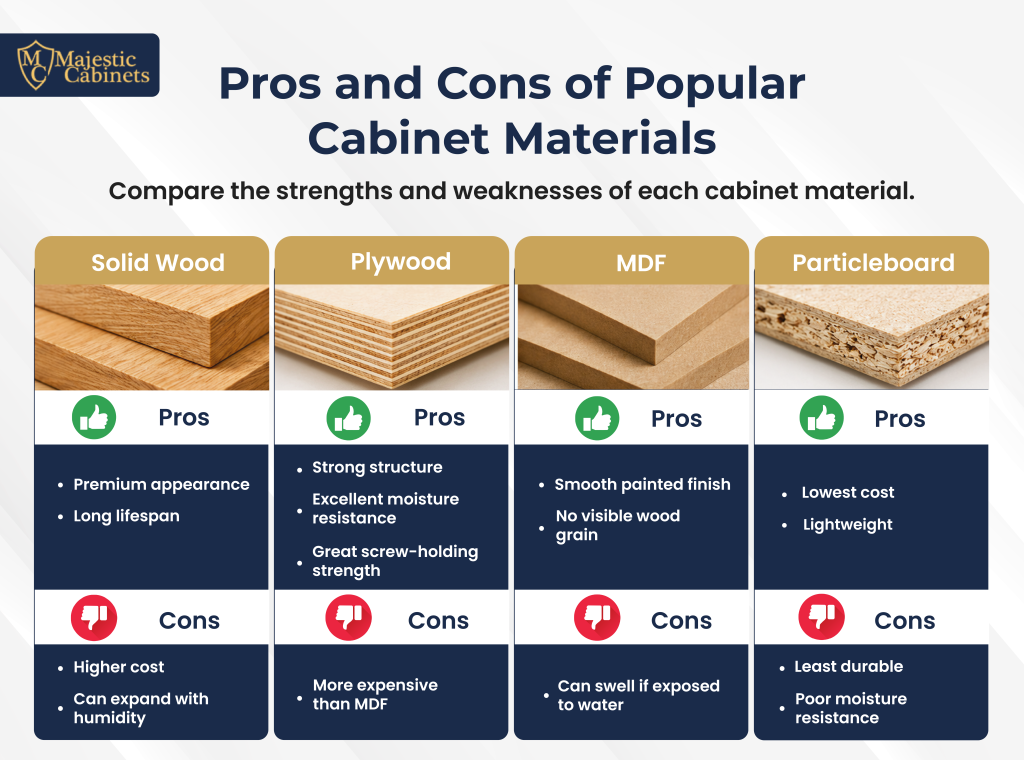
It holds screws firmly, resists warping, and withstands the moisture that naturally collects near sinks, dishwashers, and ranges.
It also shows up in flat-panel or slab-style doors, especially in modern kitchen designs, since it resists warping across large flat panels better than solid wood does.
Plus, it takes paint and veneer finishes well, though the layered edge requires edge banding to maintain a clean finish.
This material costs more than particleboard, but for homeowners who want their cabinets to hold their shape for decades, that extra cost tends to pay for itself.
2. Particleboard
Manufacturers make particleboard from compressed wood chips and resin, following standards set by the Composite Panel Association.
It ranks as the most budget-friendly option for cabinet boxes.
It gives you a flat surface that works well under laminate and thermofoil finishes, which explains why it shows up so often in stock cabinetry.
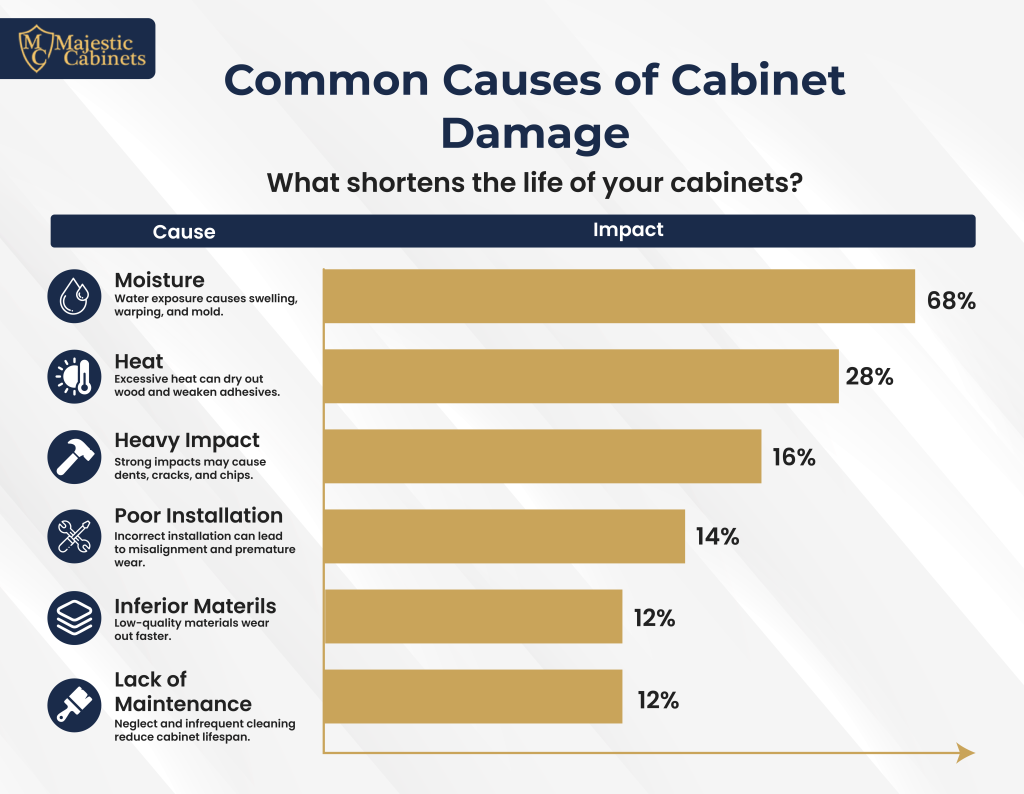
However, it doesn’t hold screws as securely as plywood, and it can swell if it’s exposed to water or high humidity for extended periods.
It’s a reasonable choice for budget-conscious remodels or lower-moisture areas of the kitchen, but you shouldn’t rely on it near a sink or dishwasher.
3. Solid Wood
Manufacturers most commonly use maple, oak, cherry, hickory, and alder to create solid hardwood cabinets.
According to research from the USDA Forest Products Laboratory, it remains the benchmark for durability, natural grain, and long-term value in cabinet doors.
You can sand and refinish it multiple times over its life, so a solid wood door you install today can look brand new again in fifteen years with the right care.
Builders rarely use it for boxes, mainly because of cost and because natural wood expands and contracts with humidity more than engineered materials do.
That said, it does occasionally show up in high-end custom cabinetry when a homeowner wants a fully solid-wood build.
Solid wood costs more upfront and requires proper sealing and finishing, but for homeowners who want real wood grain and strong resale appeal, nothing else quite matches it.
4. MDF
MDF, short for medium-density fiberboard, is an engineered wood product manufacturers make from wood fibers bonded with resin under heat and pressure, and it’s become the go-to choice for painted cabinet doors.
Its surface is extremely smooth, so painted finishes come out flawless without wood grain telegraphing through, and it holds up well to intricate routed or raised-panel detailing.
It weighs more than solid wood. Moreover, it can swell if it sits in standing water or prolonged moisture.
It also doesn’t take stain the way natural wood does, but for painted, shaker-style cabinets, it often works better as a substrate.
5. Thermofoil
Manufacturers create thermofoil by heat-fusing a vinyl layer to an MDF substrate, which creates a seamless surface with no visible joints.
It costs less, wipes clean easily, and resists chipping under normal use, so it shows up often in rental properties and cost-conscious remodels.
Heat exposes its main weak point: prolonged exposure can cause it to peel or bubble, so think twice before using it at close range or in kitchens that get a lot of direct afternoon sun.
You also can’t really repair thermofoil if it’s damaged, since the color and style options tie directly to the factory finish.
6. Laminate
Manufacturers bond a printed decorative layer to a substrate, usually particleboard or MDF, under high pressure to create laminate.
High-pressure laminate, abbreviated as HPL, holds up better than standard laminate and resists scratches and stains. It also offers a much wider range of colors and patterns, including convincing wood-look finishes.
Compared to thermofoil, its visible edges and seams stand out as its main drawback, and it can lift over time if you don’t seal it properly.
But for homeowners who want variety without the cost of solid wood, it works as a solid middle ground.
7. Melamine
Manufacturers apply melamine, a resin-coated finish, to particleboard or MDF, and builders most commonly use it in cabinet boxes, though it also appears on some door styles.
It stays smooth, cleans easily, and holds up to moisture noticeably better than raw particleboard, all at a low cost.
It can chip at the edges over time, and it isn’t built for structural use the way plywood is. For that reason, reserve it for cabinet interiors and budget-friendly door applications rather than load-bearing components.
How Does Cabinet Grade Affect Material Choice?
How manufacturers build a cabinet also shapes its material mix, since stock, semi-custom, and custom cabinets tend to use different material mixes.
Stock cabinets typically pair particleboard boxes with thermofoil or laminate doors, which keeps costs low but limits you to pre-set sizes and a narrower range of styles.
Semi-custom cabinets usually step up to plywood boxes, so you can choose between MDF and solid wood doors, and you get more flexibility in sizing and finishes.
Custom cabinets, like the ones we build at Majestic Cabinets, put the full range on the table.
We pair plywood or solid-wood boxes with solid-wood, MDF, or veneer doors, and we match everything to your exact kitchen layout, finish preferences, and performance needs.
5 Factors to Consider When Choosing Cabinet Material for Kitchen Cabinets
Beyond material, a handful of practical factors ultimately determine which choice makes sense for your kitchen. Weigh these factors before you decide.
1- Climate and Humidity
Las Vegas’s dry desert climate generally treats wood cabinetry well, since low ambient humidity means less risk of swelling over time.
That said, areas near sinks, dishwashers, and ranges still see localized moisture exposure regardless of the broader climate. For that reason, invest in plywood boxes and properly sealed doors in those specific zones.
2- Budget
Particleboard, thermofoil, and laminate offer the most affordable entry points into a cabinet project, while plywood and MDF sit comfortably in the middle.
Solid wood carries the highest upfront cost, but it often delivers the best long-term value and the strongest resale appeal. Weigh that against the initial price tag.
3- Finish Goals
If you want a painted, shaker-style door with a flawless, grain-free surface, choose MDF as your substrate.
If you want visible wood grain under a stained finish, choose solid wood, since it’s really the only material that delivers that look authentically. Engineered materials simply can’t replicate natural grain the same way.
4- Durability and Lifespan
You can sand, repair, and refinish both solid wood and plywood over the years, which extends their usable life well beyond their original finish.
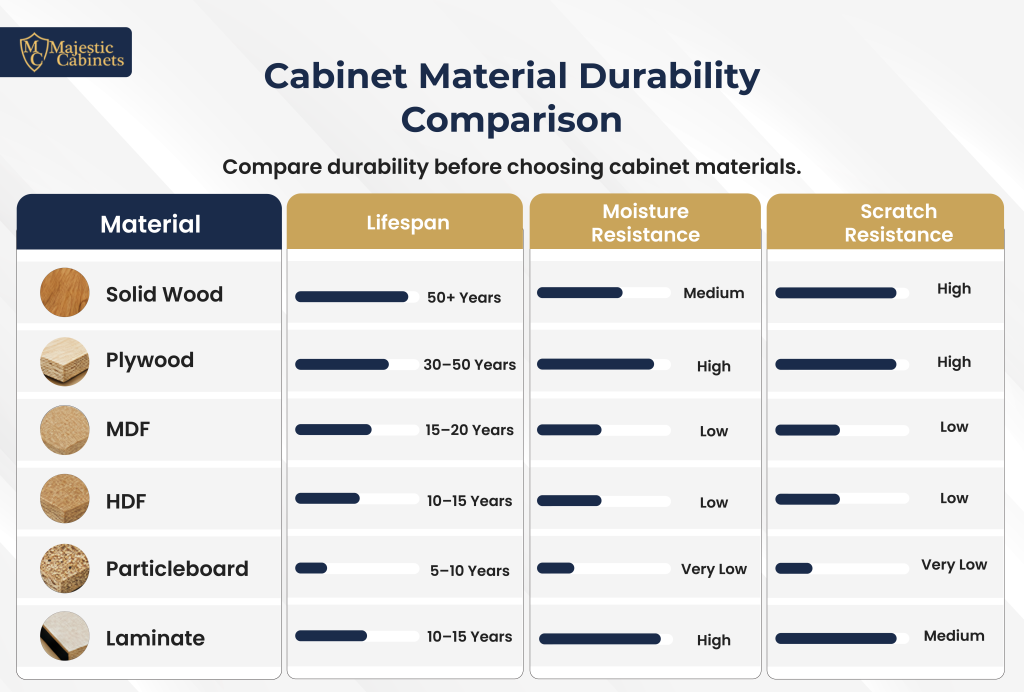
Thermofoil and laminate generally can’t be refinished the same way, so once they’re damaged, they tend to get replaced rather than restored.
5- Sustainability
Many plywood and MDF products now come with formaldehyde-free or low-VOC resin options. Ask about them directly if indoor air quality matters to your household.
Final Note!
No universal “best” cabinet material exists. Only the best combination of materials for your kitchen’s layout, budget, and daily use.
For most homeowners, plywood boxes paired with solid-wood or MDF doors offer the best balance of durability, appearance, and value.
Majestic Cabinets helps homeowners across Las Vegas, Henderson, Summerlin, and North Las Vegas choose the right cabinet materials for their kitchen from day one.
As a licensed and insured cabinet builder, we design, build, and install custom kitchen cabinets suited to your home’s climate, style, and budget.
Get a Free Quote today or call 702-457-1158 to start planning your custom cabinets.
People Also Ask
Is plywood or MDF better for kitchen cabinets?
Plywood wins for the box, since it holds up better to moisture and holds screws more securely. MDF wins for painted doors, since its smooth surface takes paint without any grain showing through.
Are solid wood cabinets worth the extra cost?
For most homeowners, yes. Solid wood costs more upfront, but you can sand and refinish it multiple times over the years, which extends its lifespan well beyond that of most other materials. It also tends to hold its value better if you ever sell the house.
What is the most durable cabinet material?
Plywood and solid wood stand out as the two most durable options, hands down. Both resist warping and daily wear far better than particleboard or thermofoil, so they become the go-to choice when longevity matters more than upfront price.
Do thermofoil cabinets hold up in Las Vegas heat?
Not always. Thermofoil reacts to sustained heat, so it can peel or bubble over time near ranges, ovens, or in kitchens that get strong afternoon sun. If your kitchen runs hot, choose a different material for those spots.
Free in-home estimate
Get a Real Quote From a Real Cabinet Specialist
The best way to understand your project is to see the space in person. We visit your home, take measurements, review your ideas, and provide a clear estimate.